

TLDR:
Shaeda is open again for Early Access. Please message below if interested.
New design
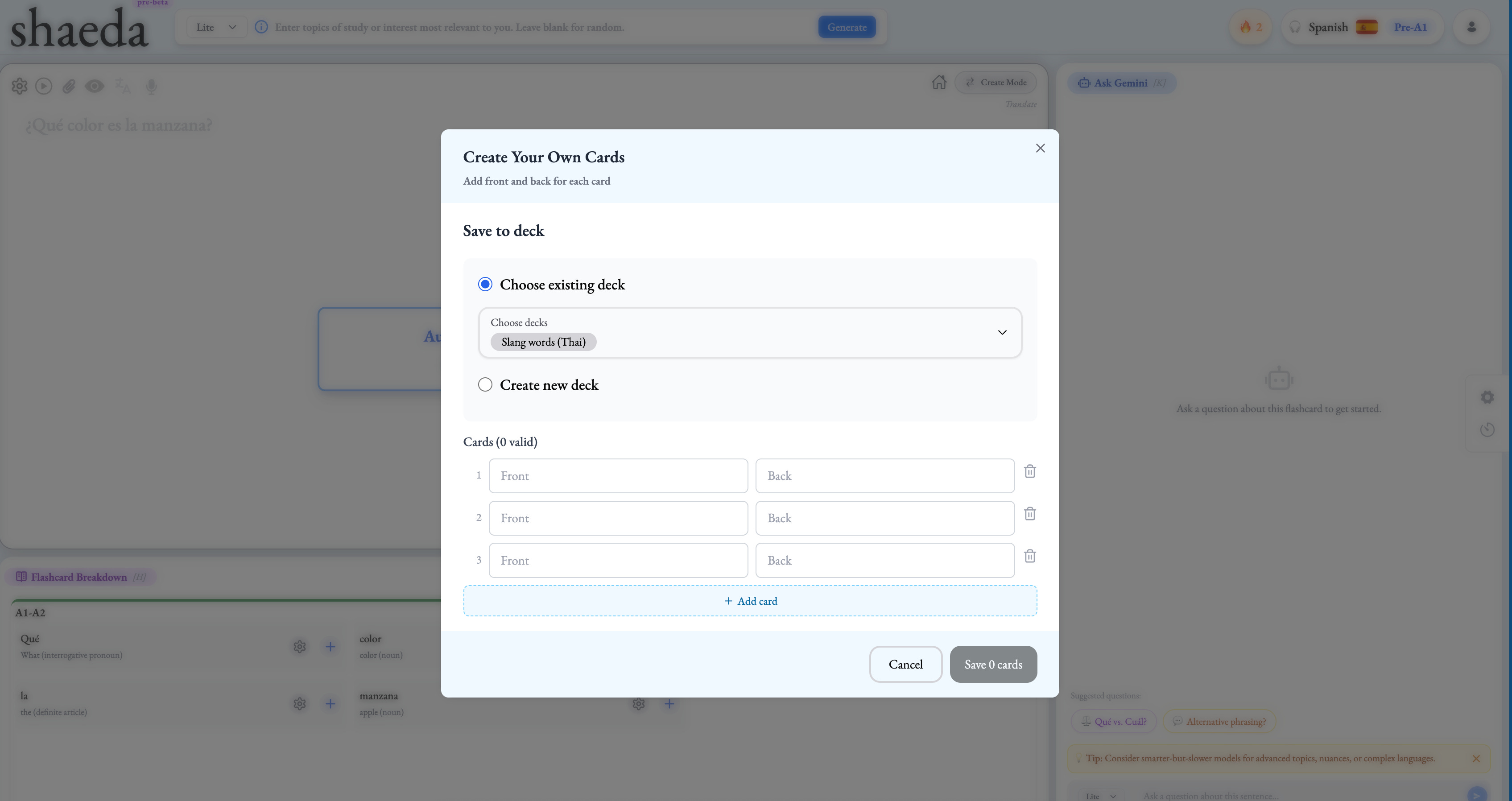
DIY self-made card feature added (ft. cat)
Ask Gemini added
Improved Flashcard Breakdown
Improved Settings/Sidebar
Early Access
Shaeda is now ready for use and is good to go for daily use as a study tool (whether that’s for Language learning or Academic study)
If you would like early access to Shaeda, or perhaps to test the accuracy of one of the as-yet-unvalidated languages (must be native/native-level speaker), please get in touch by messaging me below - my only ask that you do provide feedback if possible.
New UI Design
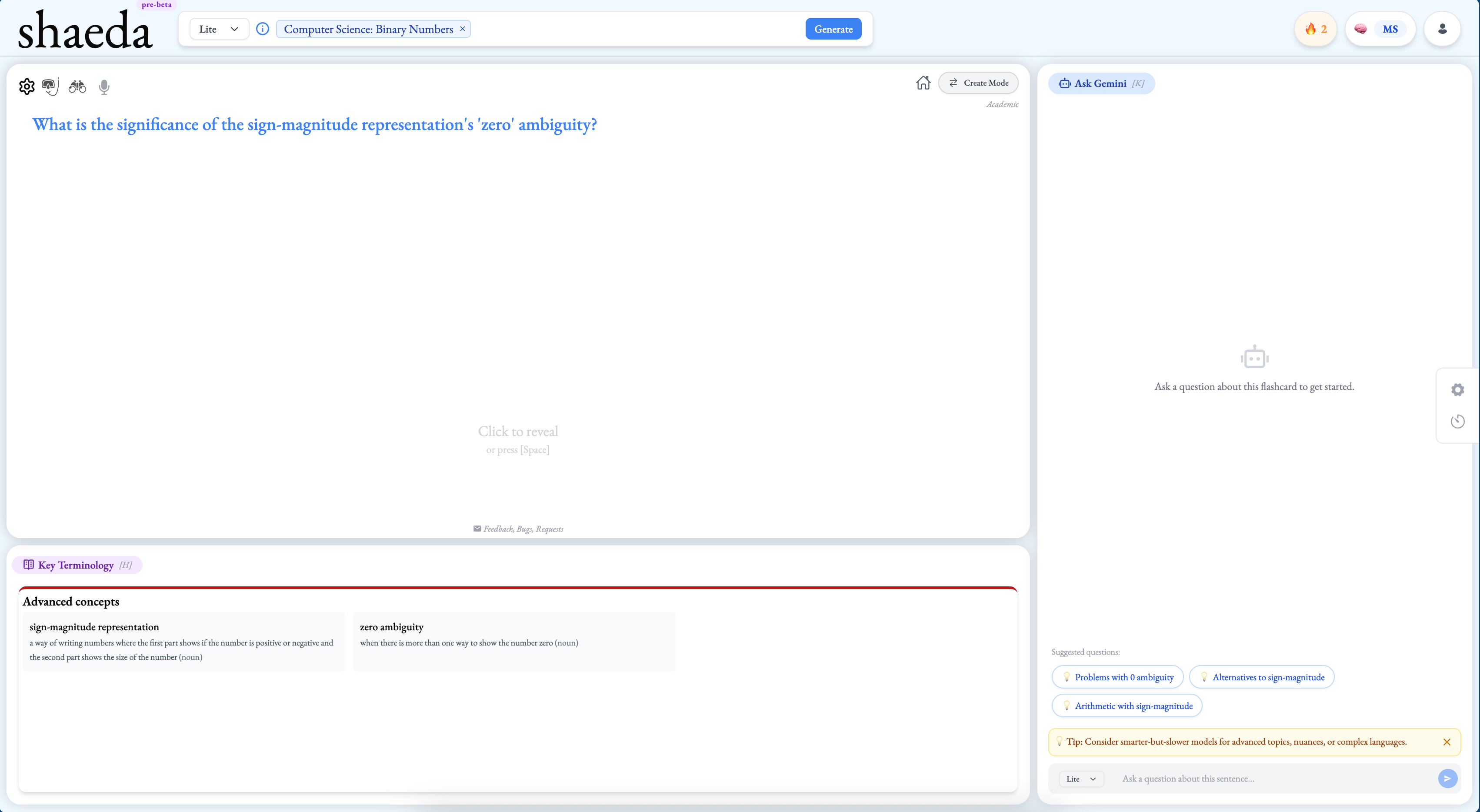
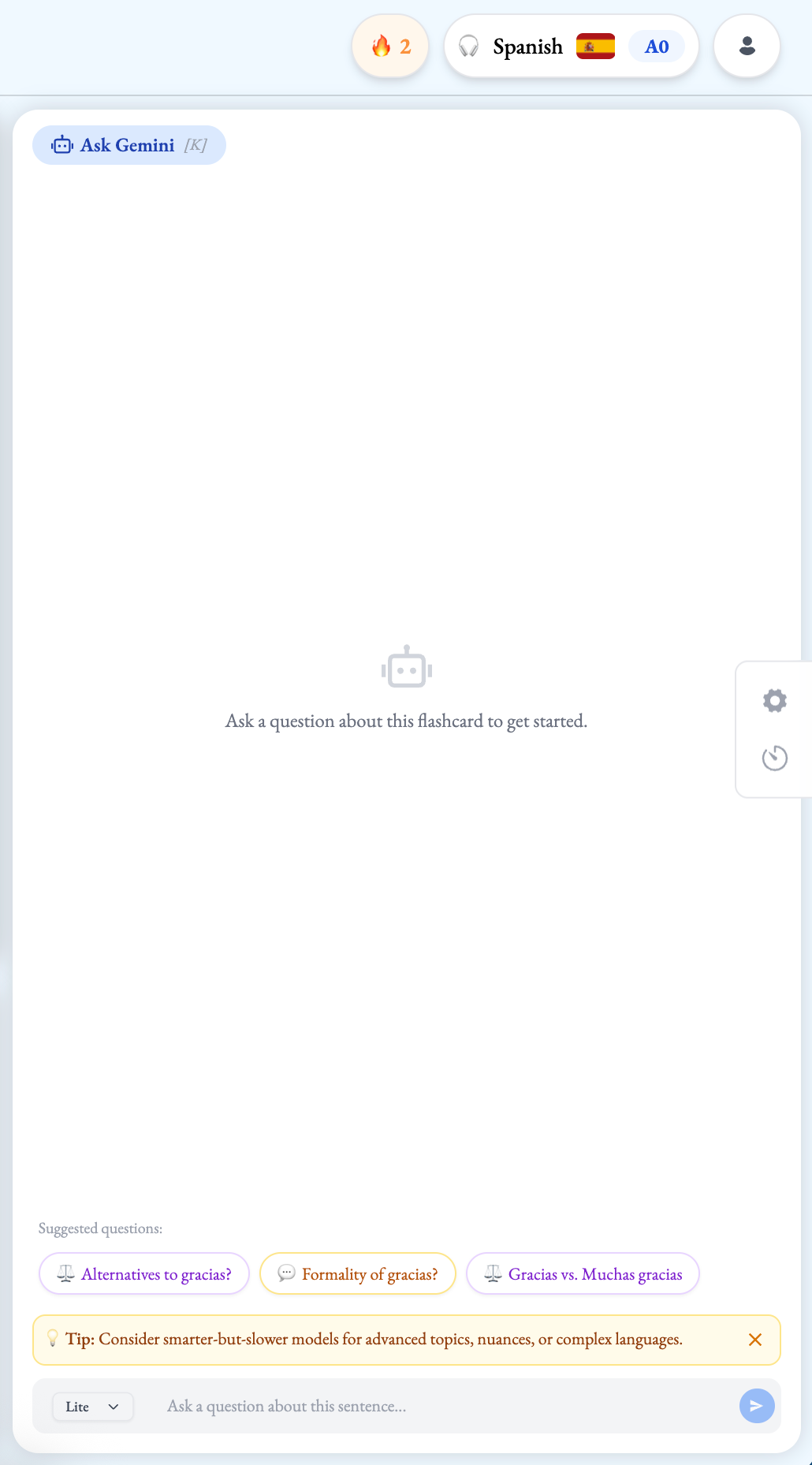
Previously the Ask Gemini was somewhat sandwiched and cramped at the bottom. It did not make sense to have a chat component horizontal as there was minimal room to scroll which made reading the chat needlessly difficult. This, as seen below, has now been moved to the righthand side which makes for a much improved layout. To be honest, I’m not sure what I was thinking not having it here to begin with.
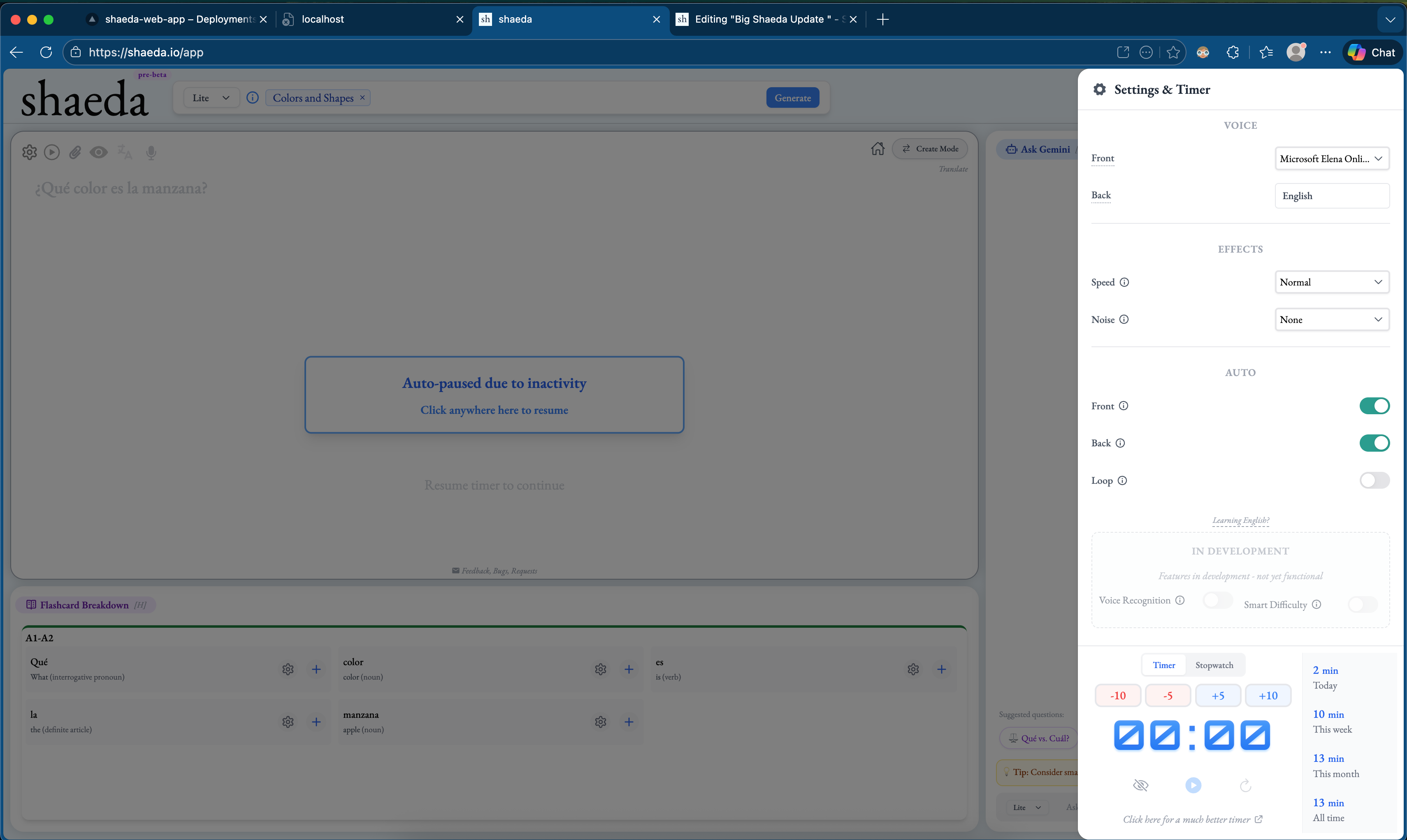
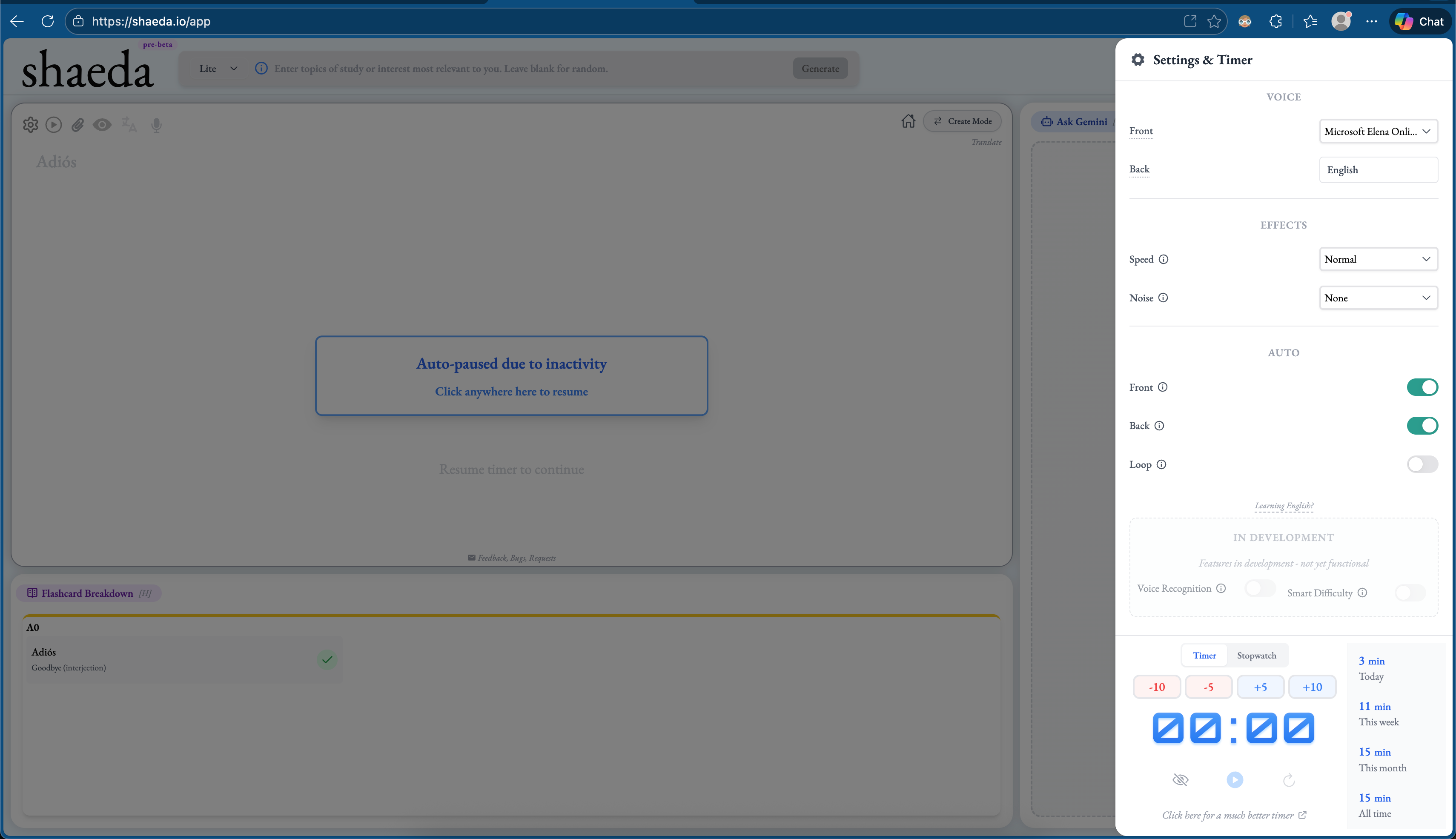
The Settings and Timer areas have been moved to a sidebar which will appear whenever the cursor hits the far righthand side of the page. There is no click required, so if you wish to change the voice, speed or background noise mid-review, it is just as simple as before.
DIY Self-Made Cards
I agree that for certain situations, DIY cards will undoubtedly make more sense than Gemini-generated ones. The issue, as always, is the trade-off. More formally this is known as Opportunity Cost. If self-made cards improve retention by, say, 20% per-card, but take 5x the effort to create (and thus the total volume of practice is substantially lower), it might not be suitable for some - especially perhaps adults who are short(er) on time.
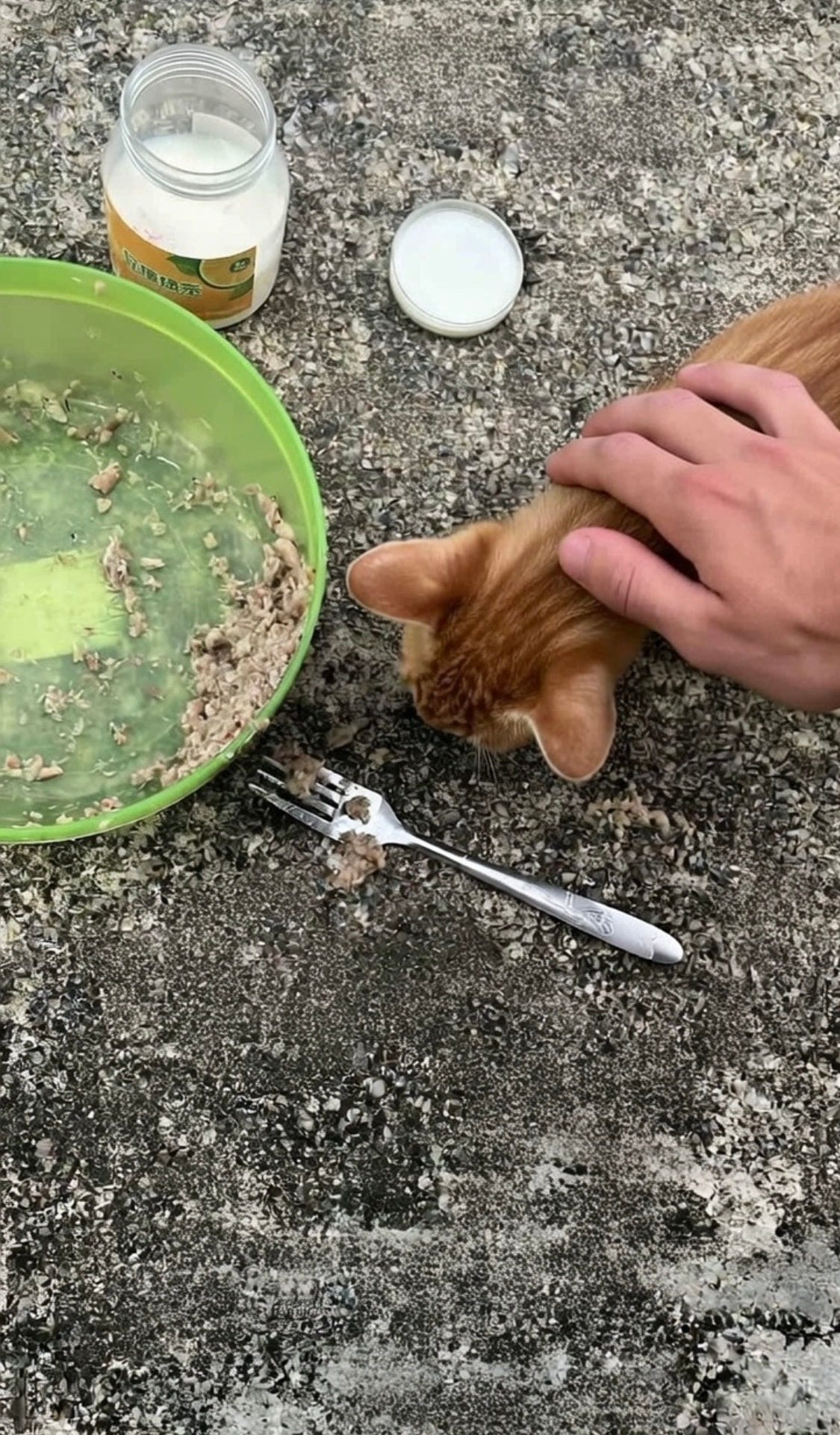
For any language learners using Shaeda for targeted, appropriate and relevant listening practice (commonly referred to as Comprehensible Input [CI]), it is unclear to me how DIY cards are a net positive tradeoff on the whole long-term: Whether the user writes “El gato callejero es tan chiquitito.” (which means the stray cat is so tiny) or Gemini writes “El gato callejero es tan chiquitito.”, those words can and will only ever be those words. Whether the user writes them or Gemini generates them, the words are still just the words: gato will still mean ‘cat’, callejero will still mean ‘stray’, and chiquitito will still mean ‘very small/tiny’.
DIY cards, however, will come into play for much more nuanced Academic topics or perhaps slang variants of words/sentences that one might have heard from natives and/or native material.
The key to remember is they likely will come with a higher per-card retention, but whether this is a worthy trade-off is not necessarily a given for everyone - context is always important.
Ask Gemini Added
The Ask Gemini feature has been added, along with a choice of models depending on the situation.
As seen below, there will also be some potential questions that appear. Usually elsewhere outside of Shaeda these suggested questions I maybe use only 25% of the time: I had a very quick question and, once answered, I did not need to know more. With Shaeda this will be higher as the app is aimed at understanding, and not necessarily just pure memorisation (which is still, in my opinion, a hugely important aspect to learning - however controversial that may be to some)
Improved Breakdown
Previously, the breakdown feature only analysed the specific inflected form of the word used on the card. This could be confusing, or just unclear, if you weren't already familiar with the word’s dictionary form. Now, the app automatically identifies and displays the base/lemma form (e.g., the infinitive for verbs or nominative for nouns), hopefully providing a clearer foundation.
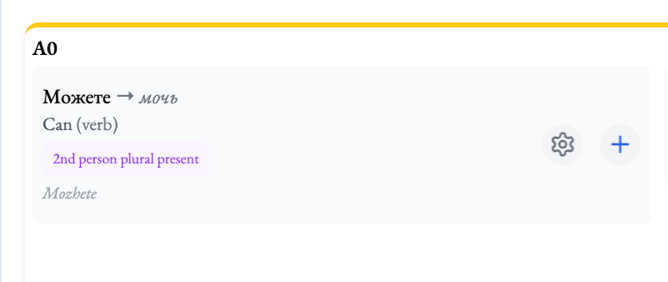
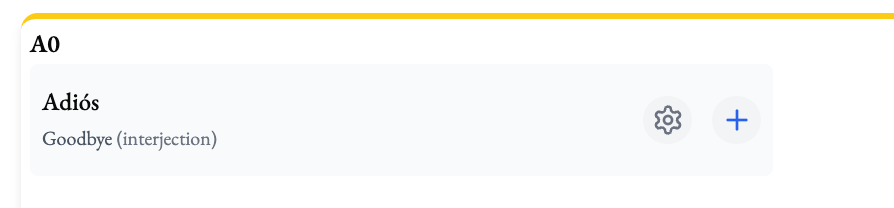
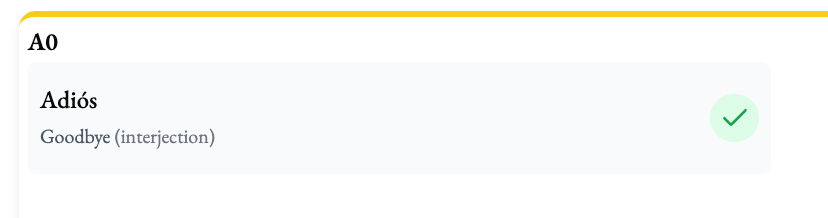
Further, it is now easier to save individual words from the Breakdown box with the Settings button to configure which deck you would like the word being saved to, or Quick Add if you are saving multiple all to the same deck.
Sidebar
The previous design was too overwhelming and cramped the key features (Breakdown and Ask). Keeping the Settings and Timer as very (very) easy access is still important though, so there are no extra clicks or navigation required to access them. Just move your cursor all the way to the righthand side and the side panel loads instantly. The actual layout and readability of the Settings section has also been improved with it having more (vertical) space and no longer cramped inside a smaller container.
Negative Feedback, Scaffolding and Gamification
So far the only negative feedback I have received is that the app has no scaffolding or gamification:
Re scaffolding, the app does provide scaffolding with Breakdown, Ask, Paperclip, DeepDive and Lookup features - it is just on the user to utilise these. If you are asked a question that you kind of know the answer to, but not as much as you would like, it is wise to use all features available to you. This is what separates Shaeda from other flashcard apps, in my opinion. Unfamiliar with a key term? Use Breakdown to isolate it and add it to your deck. Ask Gemini what it means if unsure. If it is a complex or nuanced area, use Flash or Pro models. If you are still unsure, use LookUp which will perform a Google search and allow you to read articles on the topic. Then use Paperclip (or the Search bar) to test your new understanding when you return to the app. Remember that flashcards are just questions, and answering questions is both a form of demonstrating knowledge and acquiring knowledge due to the Testing Effect (Wiki, Articles)
Re gamification (or lack thereof), indeed the app has zero gamification and will continue to have zero gamification. For anyone looking for gamification I recommend downloading Duolingo and paying 5x more than Shaeda (‘SuperDuolingo’ is $13p/m) for Super Gamification.
Ultimately there is no free lunch in learning (or anywhere, for that matter). Learning (and retaining said learning) is inherently difficult and slow and there has to be some level of discomfort in order to progress. In this regard it is no different to one starting the gym: it would be inefficient and ineffective to go and never break a sweat.
400
PS: Shaeda recently crossed 400 signups - thank you all very much for the interest! However, unfortunately only around 50% of signups actually receive these email updates. Likes and Shares, therefore, are hugely appreciated as it improves the ‘health’ of the Substack (so they say), meaning more people who have subscribed will actually receive the emails in their inbox as opposed to their spam.