

TLDR
“Feature, not a bug” (FNB) is a saying for something that feels ‘bad’ but is actually ‘good’.
An example of this is the fatigue that comes from exercise.
“Bug, not a feature” (BNF) is the opposite: something that feels ‘good’ but is actually ‘bad’
An example of this is compulsive social-media use.
High-quality, digital flashcard systems have several important examples of FNBs that students can often fail to recognise.
Low-effectiveness apps have several examples of BNFs that students can also often fail to recognise.
The result is that users may invest substantial time on methods or apps that objectively produce considerably less learning than their apparent progress or own subjective feelings suggest.
Understanding the difference between FNBs and BNFs can help distinguish features that feel productive and those that are productive.
Students who understand how to study effectively consistently make greater progress, and in one recent study were 2x more likely to receive an A grade, and 3x more likely to pass.
Introduction
Our brains are the product of more than ~500m years of vertebrate brain evolution. They support cognitive abilities that far exceed what their relatively small size might suggest. They can remain functioning despite being partly missing (see here, here and here). They can even continue doing cutting-edge physics after having a high-energy proton beam, travelling at nearly the speed of light, penetrate directly through them.
Unfortunately, our brains are often also poor at judging some of it’s own limitations. The same brain that will instinctively pull a finger away from a hot surface before the individual realises is also easily coerced into activities that are generally deemed fairly unhealthy (over-consuming fast-food, compulsive social media use).
Worse, the same brain that recognises and accepts the importance of studying will very often convince a student not only that the most effective means of studying are the least effective, but can also often convince them that the least effective methods are the most effective!
Why is this? Why can methods that produce less learning very often feel more productive, while methods that are productive can often feel less productive? And what can an individual do to best increase their chances of success with regards to their studying?
Feature, Not A Bug (FNB)
A feature, not a bug (FNB) describes a characteristic that initially appears undesirable, but actually exists to serve an important function. Simply, it is something beneficial that is there for a reason. Traffic lights, password requirements, exercise fatigue and so on are examples of FNBs. All of these are things that at the time feel ‘bad’, or at the very least not desirable, but nonetheless are there for a reason: traffic lights are there to make journeys smoother and safer; password requirements are there to prevent accounts from getting compromised; respiratory rate increases during exercise in order to meet the increased oxygen demands. These things are all FNBs.
As it so happens, digital flashcard systems have their own FNBs.
Backlogs
A common concern regarding the use of digital flashcards is that if they are left for a few days there will be a backlog of cards to work through upon return. This is seen as a bad thing - it is seen as a bug.
The problem is that this is an FNB. Not only is it not a bug, it is actually an important feature. When a user misses several study sessions, overdue material accumulates because the spaced-repetition system (specifically, the scheduling algorithm) continues to account for reviews that were scheduled in order to prevent or reduce forgetting.
In fact, one reason that a large percentage of learning-based websites, apps or study methods in general often produce poor long-term learning and retention is that this cumulative review feature is absent, or heavily reduced. This can often give rise to a not-widely-known concept in research known as the Illusion of Competence: the observation that students very often overestimate their own progress and knowledge in the absence of it having it tested.
A learner cannot reliably determine whether information remains retrievable without attempting to retrieve it themselves, unaided. How exactly is an individual to know whether they have forgotten material if they are not required or reminded to think about said material? I, fact, it can almost be thought of as a loose form of Schrödinger’s cat. Until the student does attempt to think about it, only then will they be able to tell if they have retained it.
A low cognitive-effort method or app can often allow learners to progress through a large amount of material rapidly, with minimal attempt to establish how much of said material will remain retrievable later. Users therefore can often continue encountering new material, further increasing their feeling of progress, without being required to actually demonstrate retention of prior material.
A flashcard backlog therefore is just a reflection of a fundamental property of memory: information generally becomes more difficult to retrieve when it is not successfully revisited over time. This is one reason the principles underlying effective flashcard use (recall and spacing) are so well supported by decades of research. Put simply: use it, or lose it.
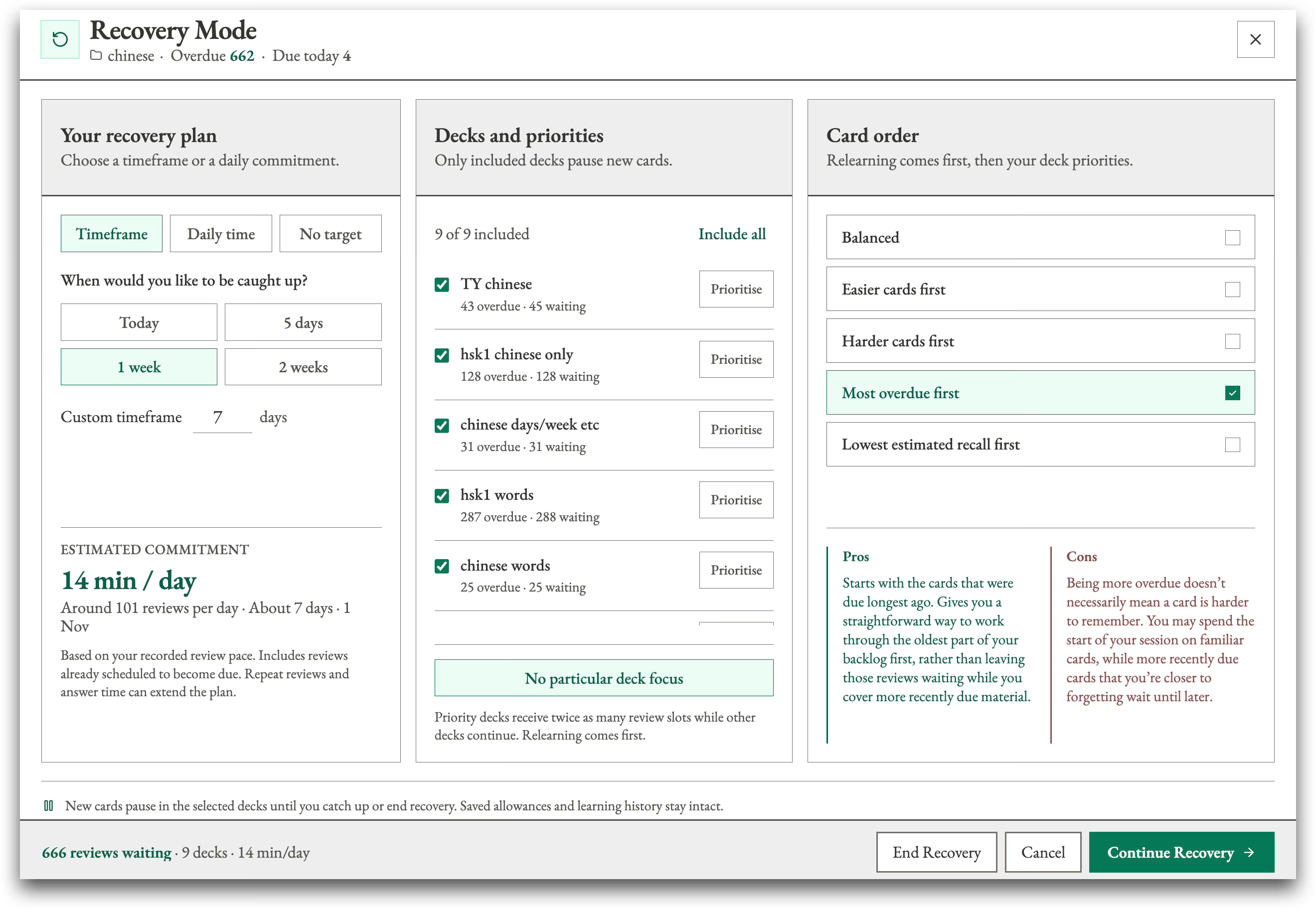
(Note: Shaeda has an in-built Recovery Mode feature designed exactly for this purpose. In the event that some days are missed, users will be prompted to consider using Recovery Mode in order to assist getting back on track in the most optimal way.)
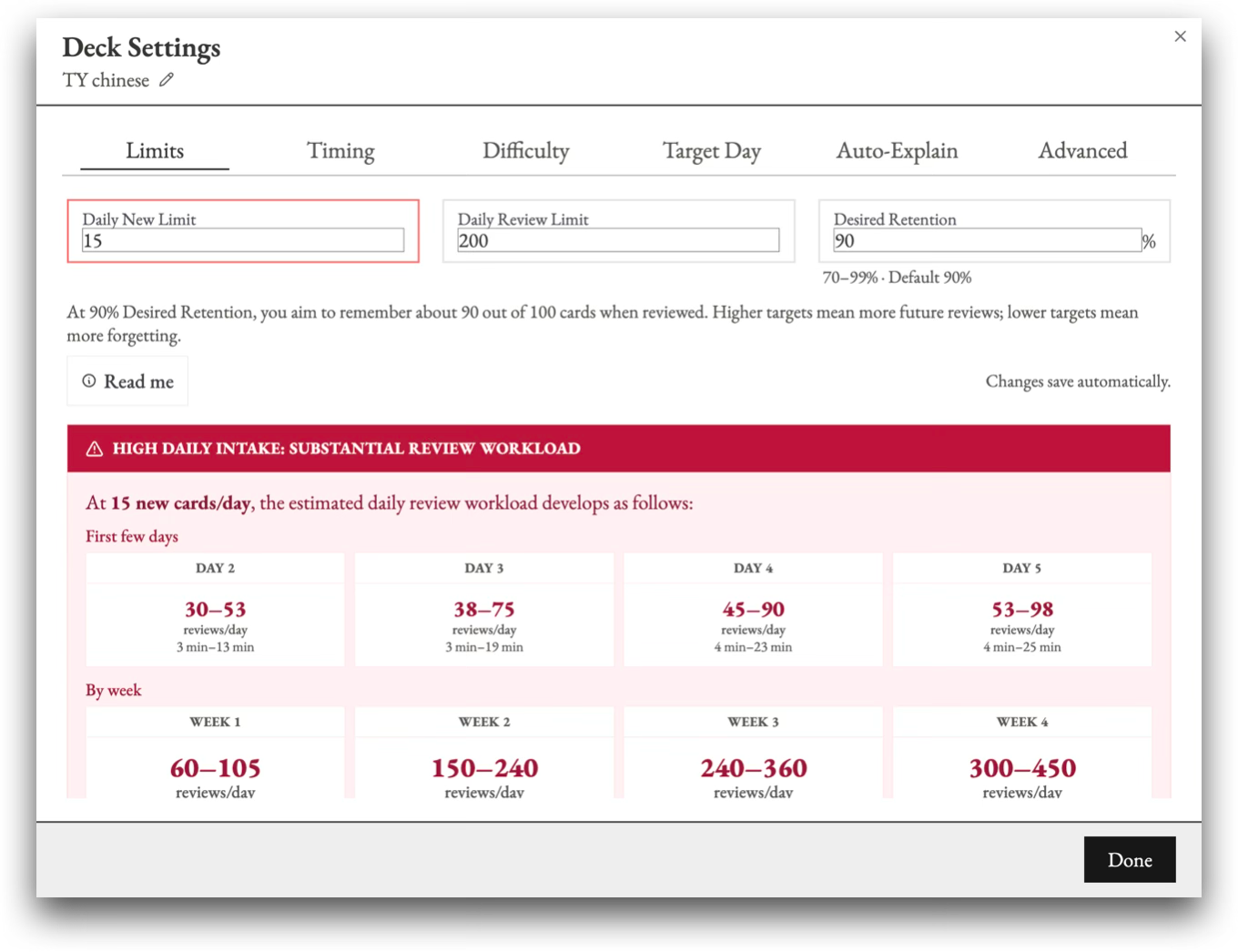
[Important: A very common scenario for users who are new to flashcards is to cover too much new material, or create too many new cards, right away. On Shaeda, we have tried to prevent this by setting up learning plans from the beginning and calculating a overly-conservative Daily New Card limit based on the context of what you are learning. It is strongly recommended to adhere to this, starting slow and gradually building up. Introducing excessive amounts of new material at once can create review demands that quickly become unsustainable. For example, consider drinking from a bottle of water: tipping the bottle upside down and squeezing will certainly rapidly increase the rate at which water will leave the bottle, but the majority will simply be wasted as it overflows from one’s mouth. Introducing new material behaves similarly: beyond a certain point, increasing the rate of exposure beyond what’s manageable creates more future review than the learner is able to realistically maintain.]
Effort and Fatigue
Another common concern regarding flashcards is that they can be mentally fatiguing. Indeed this is true: being required to recall an answer unaided is considerably harder than simply rereading notes or recognising the correct answer from a multiple-choice list. Both of these generally require substantially less effort, which is why they often provide substantially less retention and learning.
Luckily, this greater cognitive load of flashcards is a feature, not a bug.
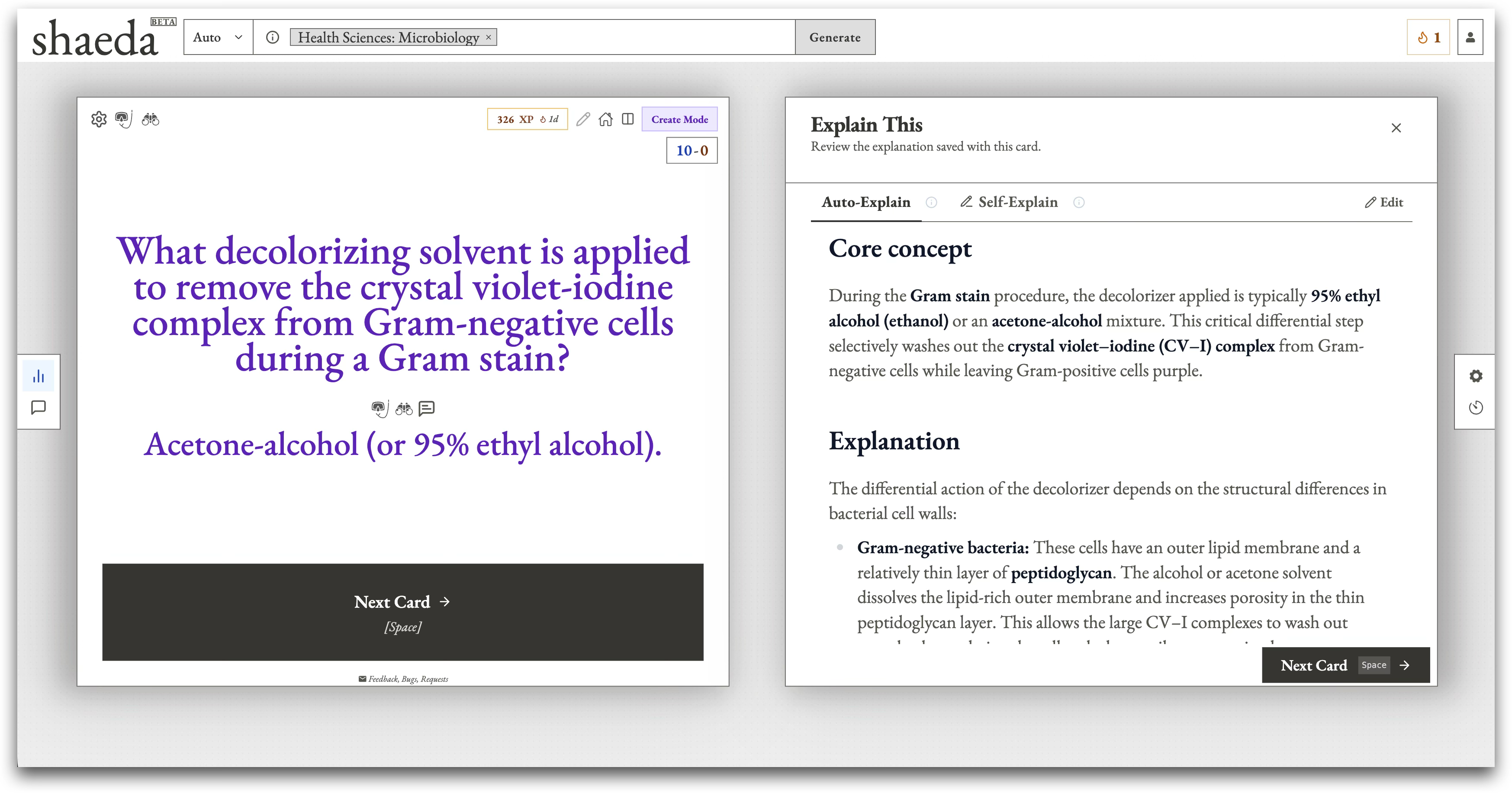
The greater effort required by recall practice is one of the reasons it is so effective. In other words, if the greater effort was not there, it would not be nearly as effective. Retrieval does not simply test whether something has been learned. Of course it does do that, which is an additional benefit, but the actual act of attempting and successfully retrieving material itself is a strong form of learning. In research this has been a very robust finding for decades known as the Testing Effect. Naturally, students see ‘tests’ as something that is done at the end of a learning period in order to test for knowledge. This can often make it confusing and difficult to understand that the very act of being ‘tested’ not only is an effective means of learning, it is actually one of the most effective forms of learning. Flashcards do both, and at the optimal time.
It ties in to something that researchers call desirable difficulties: conditions that can make learning feel slower or harder during practice, while improving learning later. In other words, the fact that a study method feels more difficult does not necessarily mean it is working less effectively. Very often, the opposite is true.
So yes, flashcards can be tiring. Effective retrieval is cognitively demanding. But provided the difficulty is appropriate*, that additional effort is not necessarily a bug in the method, it is instead a feature.
[*Important: Fatigue can also be unproductive, depending on the quality of the cards. If the cards are too difficult, too long, poorly worded, or not relevant, they will not be effective. This is the risk to creating one’s own cards: if the student does not know general principles behind effective flashcards, their cards can easily become low-quality, fatigue will become excessive and their studying will become ineffective. Flashcards on Shaeda are designed around these principles automatically: atomicity, concise wording, direct relevance, broad coverage and level-specific.]
Bug, Not A Feature (BNF)
A bug, not a feature describes something that provides a subjective benefit while producing an undesirable underlying outcome. Simply, it is something that feels ‘good’, but is actually ‘bad’. Eating fast-food, staying up late to watch films and compulsive use of social media are familiar examples of these. All of these things are things that, at the time, feel ‘good’ despite being ‘bad’ over the long-term.
These things are bugs, not features.
As it happens, many study apps or websites make product design choices that function as BNFs. These BNFs generally fall into two categories: A) design choices that reduce the cognitive demands of the learning task, and B) those that redirect attention or motivation away from learning itself. Some common examples are below:
Recognition-heavy multiple-choice questions
Cloze-deletion-style questions with answer options provided
Highly salient and interactive visual design and animations
Leaderboards prioritising activty
Pseudo-questions
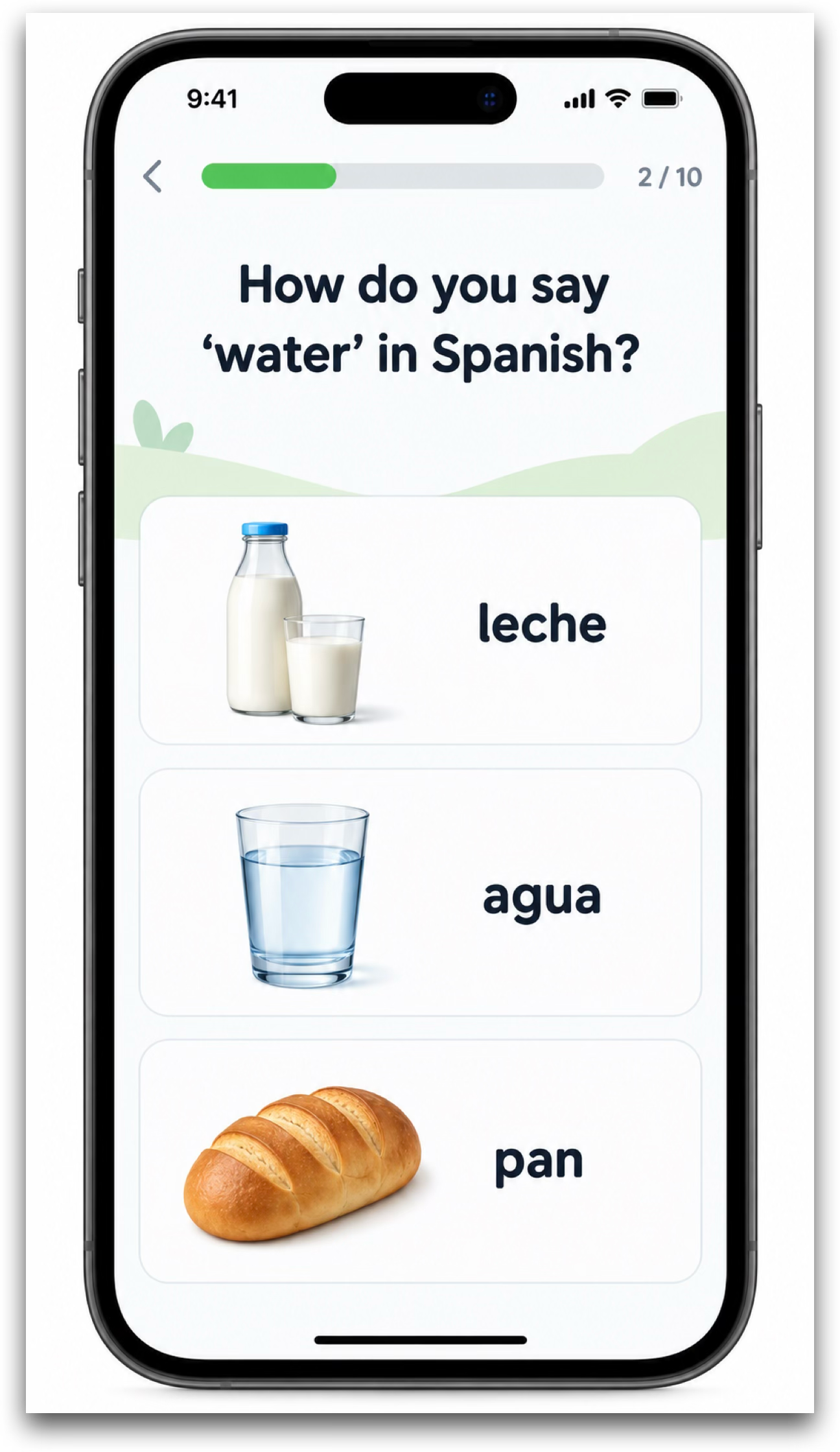
Naturally, the resulting high success rate often creates a strong, subjective impression of rapid learning. The student, however, is likely to only realise they were not learning later on. This is again related to the Illusion of Competence.
What To Do?
The subjective feeling of progress is a poor measure of learning. When evaluating a study method, website or application, learners should instead try considering what the system is actually requiring them to do.
For instance, students can consider asking themselves questions such as:
Am I being required to repeatedly retrieve information unaided?
Am I repeatedly revisiting earlier material, ideally at an algorithmically-determined date and in a systematic fashion?
Could I still produce and explain the answer if the interface, hints and answer options were all removed, as would be the case in real life?
What is ‘progress’ actually measuring?
Is the app or website providing detailed statistics for me to track my learning?
Am I progressing too quickly without any degree of effort required?
A simple rule may simply be: remain sceptical of any learning system in which substantial progress can seemingly be made while requiring very little effort or thought about the material itself.
Summary
How productive studying feels and how much learning it actually produces are not always aligned. In fact, they are often often at opposite ends of the spectrum.
Some characteristics of effective learning (effortful retrieval, repeated review, forgetting, interleaving, and the accumulation of overdue material) can, and often will, feel undesirable despite serving an important function. These are features, not bugs. Conversely, features that make learning feel fast, easy and rewarding can, and again often will, inflate the appearance of progress without producing equivalent gains in knowledge. These are bugs, not features.
When evaluating a study method, the single most important question is “Am I actually learning, or does it just feel like I am?”