

If you’re a teacher, parent or a student, this is probably the most important blog you’ll read for a long time. It is a short article outlining the (relatively speaking, unknown) research on grades achieved between students who do use flashcards, and students who don’t.
The only digital flashcard systems I recommend are:
Anki (free and customisable, but will require some effort setting up, configuring and will require different add-ons [be wary of under-appreciated security risks])
Shaeda (free or premium plans [$2.75/m]. Minimal effort to set up. Tonnes of unique-to-Shaeda, beneficial features. Detailed statistics and progress tracking. Validated by real teachers.)
TLDR
Recall and Spacing are the two most well-supported study techniques for long-term retention. No other study methods come close.
Interestingly this is not widely known, or at the very least is not appreciated.
Digital flashcard systems (DFS) not only combine both of these techniques, but also optimise them automatically.
A substantial amount of research shows that students who do use DFS repeatedly achieve much higher grades than non-users.
There seems to be a dose-response relationship: the more one uses DFS, the better their grades.
Top students know this and therefore know which methods to use, and more importantly, which to avoid.
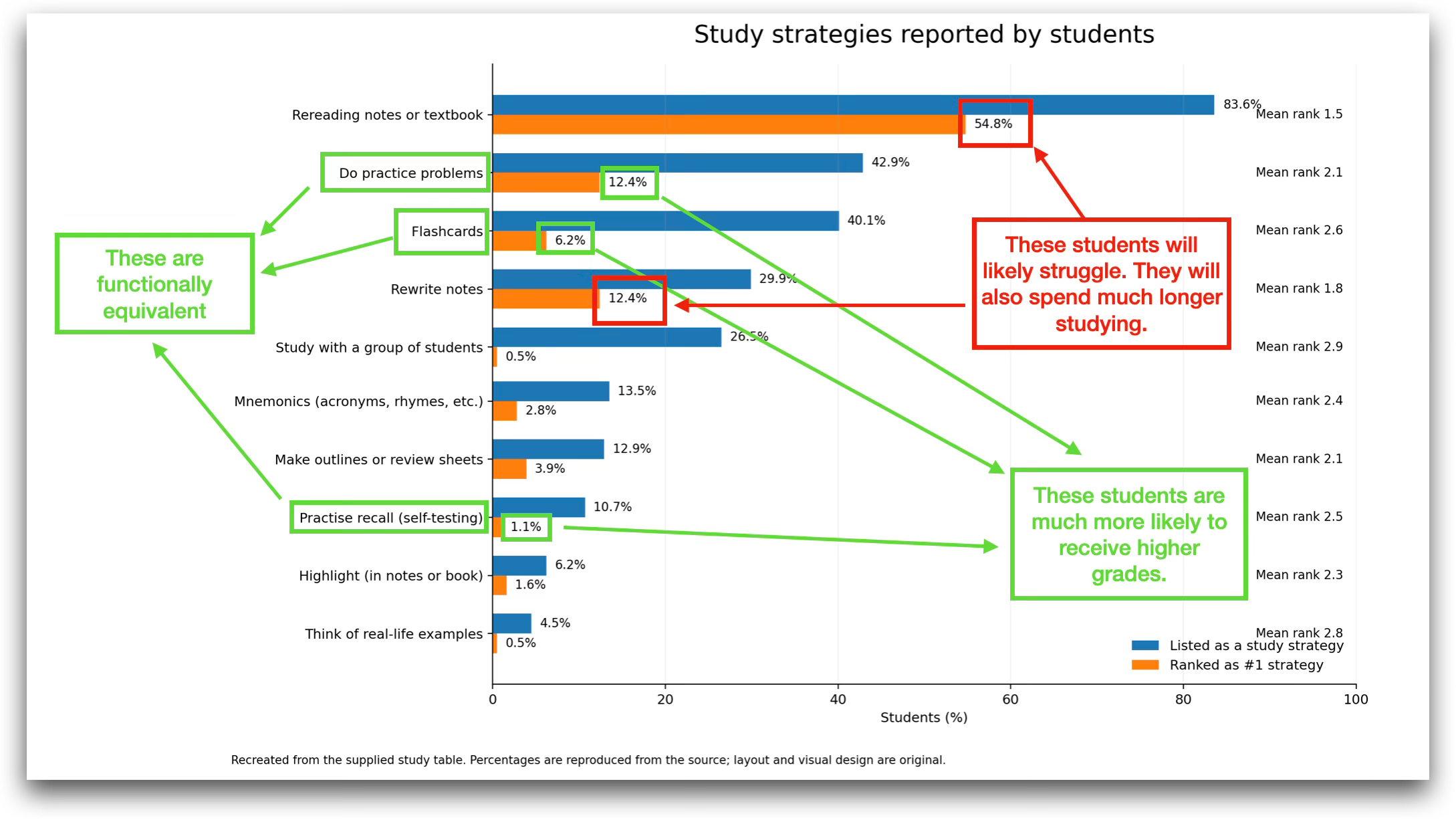
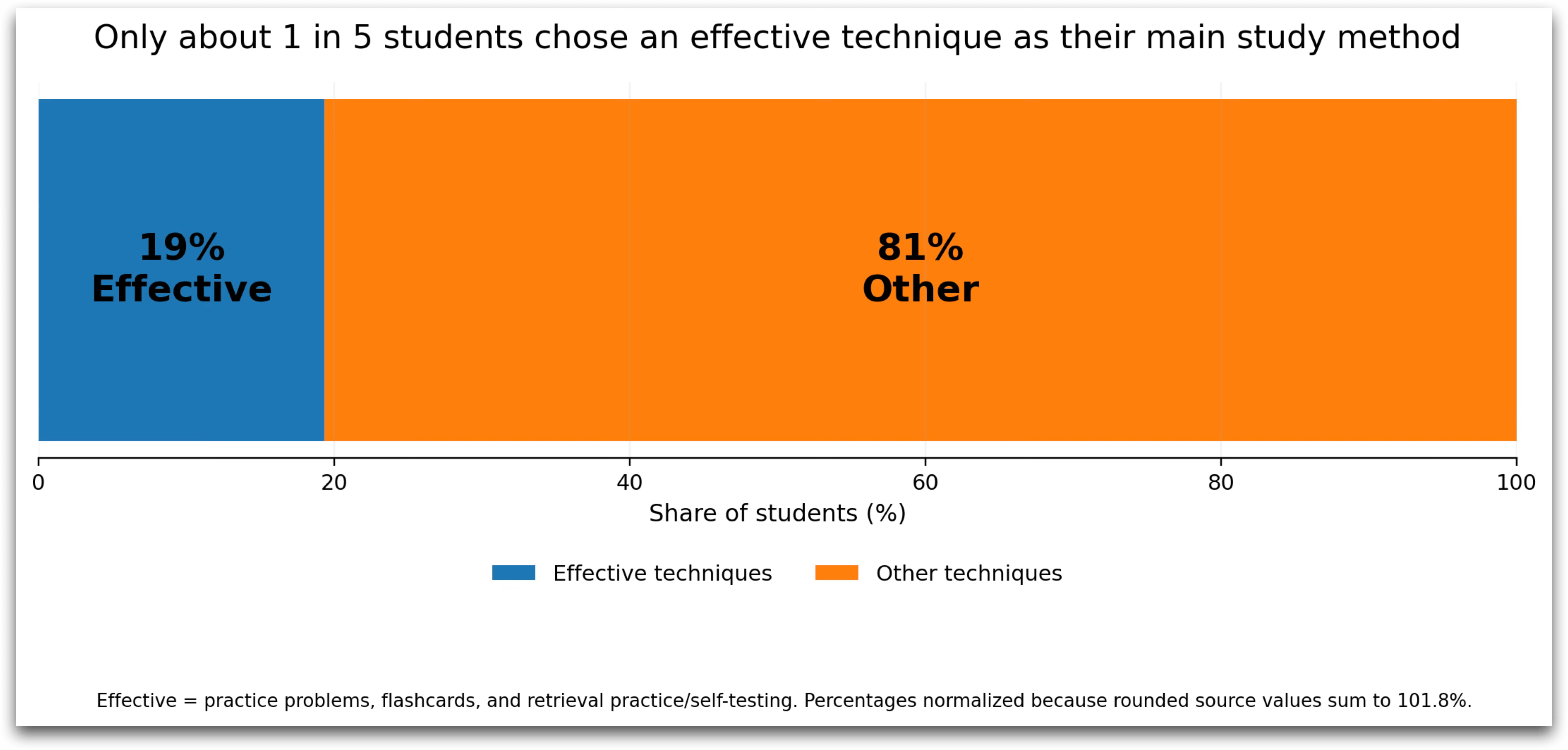
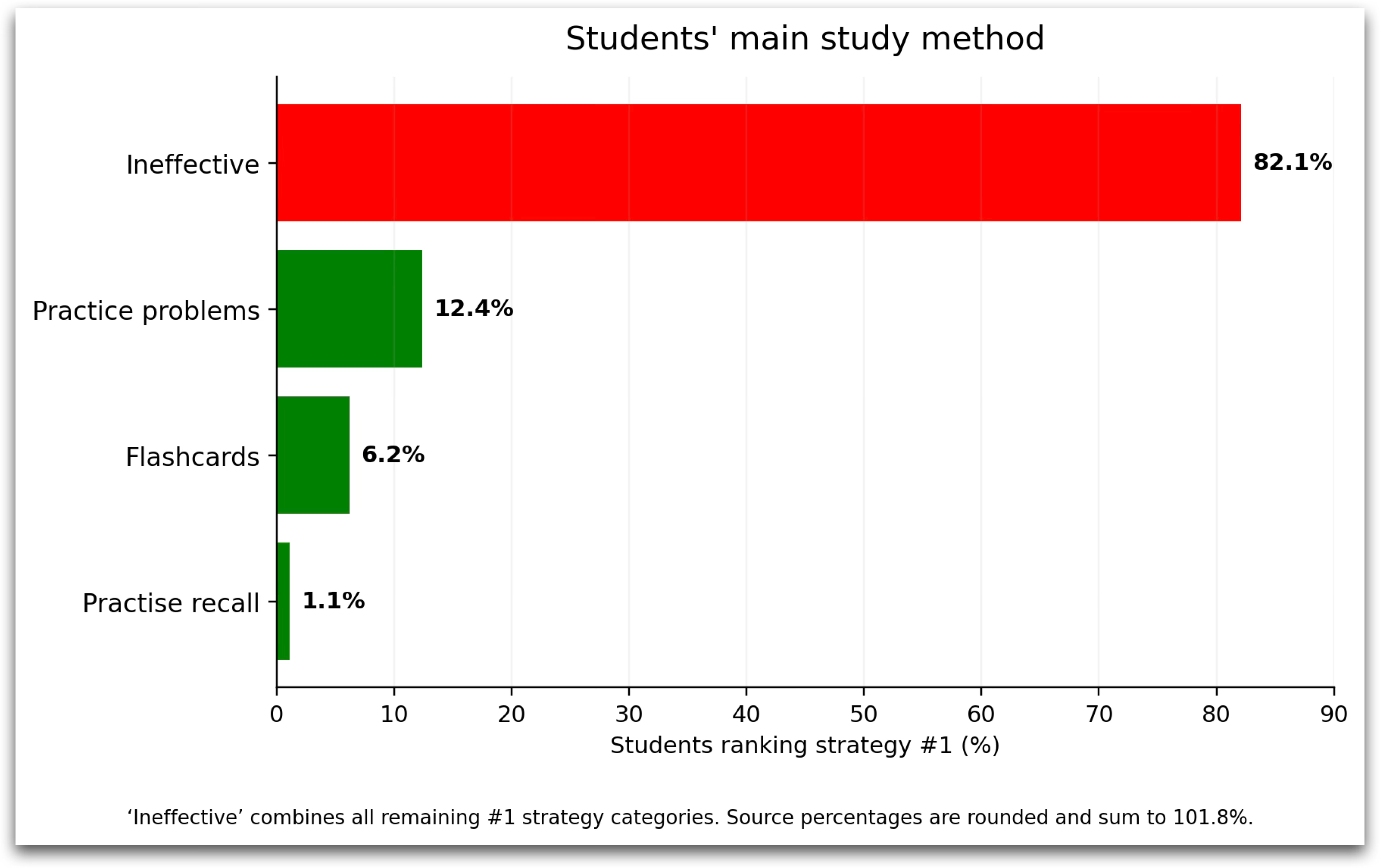
Not only do the majority of students not, they actually report not only using the least effective techniques the most often, but also the most effective methods the least.
The result is that an alarming number of students are currently not achieving their full potential, or even close to it, for no good reason, and are instead wasting essential study hours every day.
Introduction
Digital flashcards systems (DFS) have an interesting reputation.
A lot of students report that they are are the best thing they ever incorporated into their study routines. Others insist they did nothing and proceeded to quit them after a few days.
Amongst those who do use: some report they are good, but only for xyz topics; some report they are useful, but only for abc topics; others report that they are not useful for xyz or abc, but are useable for rwq subjects - but only for certain parts. Bizarrely, some even report that they should be used for some languages but avoided for others.
And others, such as readers of this blog, can see that this is silly.
There is no reason to think that flashcards would work for x retention-required-subject but not for y. In fact, the very fact that there is such widespread variance in which subjects students do and don’t feel they work is in fact evidence that they can work for them all. Flashcards are just questions. To suggest that ‘being able to answer questions’ doesn’t work for a particular subject or language is a flawed view that is not based in any reality.
Studying, ultimately, is a game mostly of (slowly) increasing the amount of material one can remember and recall. Not how much one can read and recognise, but how much one can remember and recall. That is by far and away the key ingredient.“Show me how much you know about x” is all exams, homework, meetings or job interviews are, fundamentally.
Just as with, say, a meal or a car, it is not the only part. Just the key part (naturally, the amount of material able to be accurately remembered and recalled is also the key part behind the improvements in LLM intelligence. After all, why wouldn’t it be?).
Two of the most consistently supported principles in learning science are Recall and Spacing. Recall means attempting to retrieve information unaided; spacing means intentionally distributing that over time. A modern DFS essentially combines both and optimises them: the student has to retrieve an answer, and the card is then returned at an optimal date for another retrieval attempt:
If a card is successfully recalled, the learner not only improves their retention there-and-then, they also confirm to themselves that they know this material, and they also increase this cards interval, thus reducing their daily workload going forward.
If unsuccessful (that is, the material was forgotten), the student has now made themselves aware that they do not know the material, and the system will now be automatically updated to reflect that, having them revisit this material more often.
Over days, weeks, months and years, their total progress will then be easily and objectively tracked. They can clearly see their objective strengths and objective weaknesses and prioritise accordingly. How are non-flashcard students doing this? Well, they are not. This is why they do not do as well on average.
The obvious question, then, is whether DFS’s actually translate into better academic performance outside of lab experiments. As it so happens, we actually have some research suggesting that it does.
In fact, we have quite a lot.
And alarmingly, students, teachers and parents are generally not aware of the depth and volume of this research.
2x The Odds Of An A
This paper has already been covered on the blog, but it’s worth going over again quickly. It involved nearly 800 university students. Researchers supplied them with a DFS to use and then compared exam performance at a later date between users and non-users.
Interestingly, only around one-third of the students who were given access actually used them. Looking back, they probably wished they did.
Flashcard students:
Scored much higher on the final examination (d = 0.42)
Had nearly 3x the odds of passing
Had 2.3x the odds of achieving an A

Ingebrigtsen, M., Sæle, R. G., Miland, Å. O., & Bastesen, J. (2024, November 9). Effective, scalable and low-cost: The use of teacher-made digital flashcards improves student learning. https://doi.org/10.17605/OSF.IO/2MYFA 
Ingebrigtsen, M., Sæle, R. G., Miland, Å. O., & Bastesen, J. (2024, November 9). Effective, scalable and low-cost: The use of teacher-made digital flashcards improves student learning. https://doi.org/10.17605/OSF.IO/2MYFA


Importantly, flashcard use remained associated with better exam performance even after the researchers accounted for previous academic performance, age, study time and how much material students had covered.)
More Flashcards = Better?
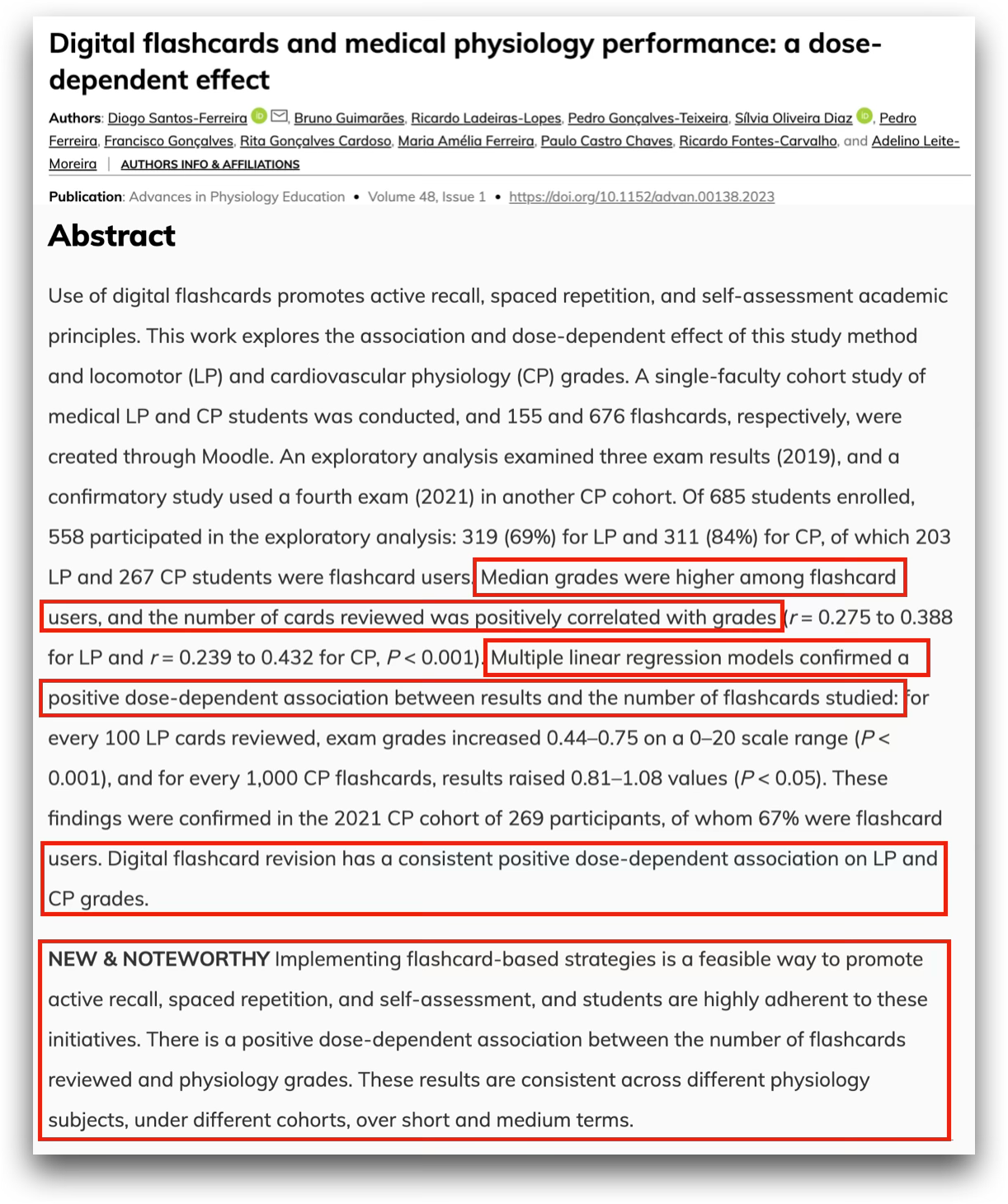
Here is another particularly useful (observational) study involving ~600 university students studying two topics within medical physiology. Rather than simply dividing students into flashcard user and non-flashcard user, researchers instead recorded how much the flashcards students had actually used their flashcards.
The result was a consistent dose-response relationship: the more flashcards one studied, the more they learnt and the better they did on exams.
For the first of the two subjects, every additional 100 flashcards reviewed were associated with an ~0.44–0.75 point increase in their grades. And in the second subject, every additional 1,000 reviews were associated with an ~0.81–1.08 point increase.
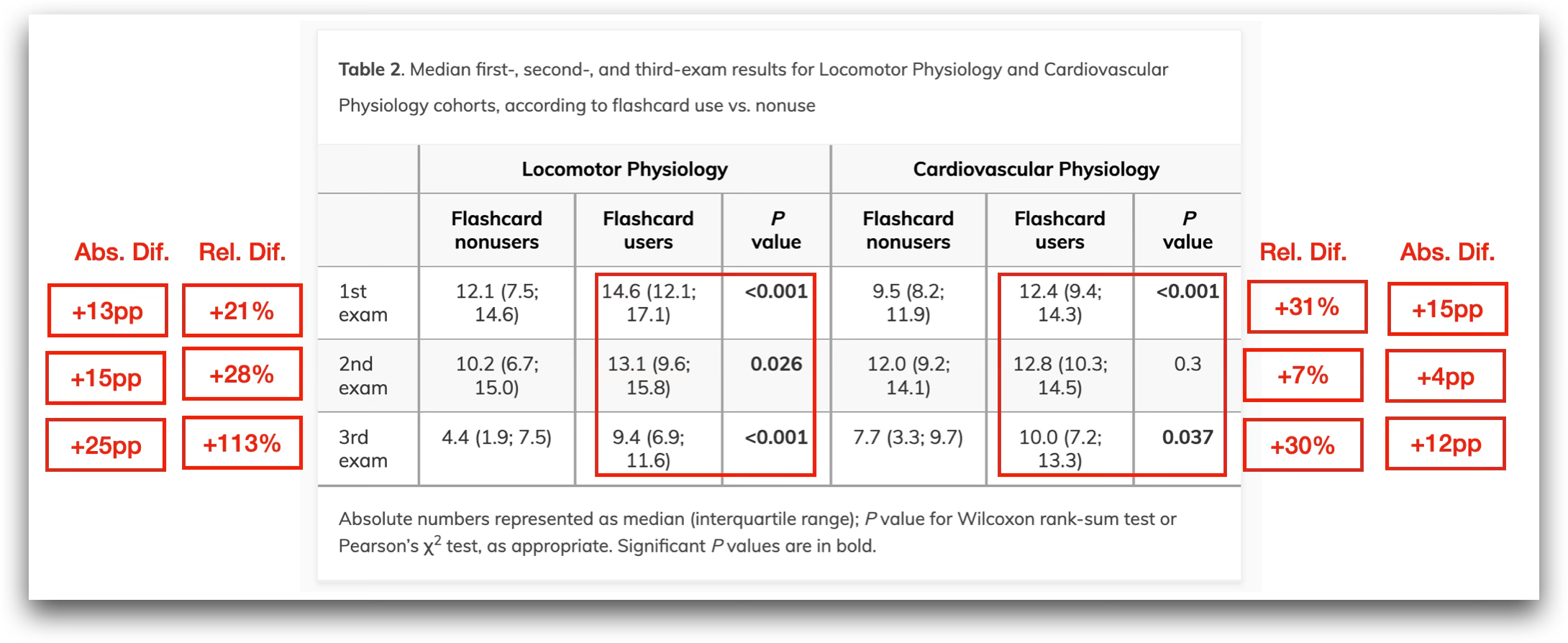
Of course, yes this was an observational study. Students were not randomly assigned to review 2,000 flashcards or 20, so we cannot say with certainty based on this one study that the extra reviews themselves directly caused the higher grades. More diligent or motivated stronger students may simply have been more likely to use the flashcards in the first place, for instance. But we are building an increasingly clearer picture.
What makes the finding more interesting though is that the relationship did not disappear after the researchers tried to make adjustments. Greater flashcard was still significantly associated with higher exam performance after adjusting for things such as age, sex, and previous performance and failure. Across the original six exams, the relationship between the number of flashcards reviewed and exam score was consistently positive, with correlations around r = 0.35. In other words, the effect of flashcards was consistent and moderate, appearing repeatedly across different exams rather than being driven by one particularly favourable result.
What’s more, the researchers then looked at a separate cohort two years later and found the same pattern again, which is not included above (they do not provide a table). In this separate, second cohort, flashcard users scored a median 11.6/20, compared with 8.6/20 amongst non-users, while the number of flashcards reviewed was again positively associated with performance.
What Happens When You Experimentally Test It?
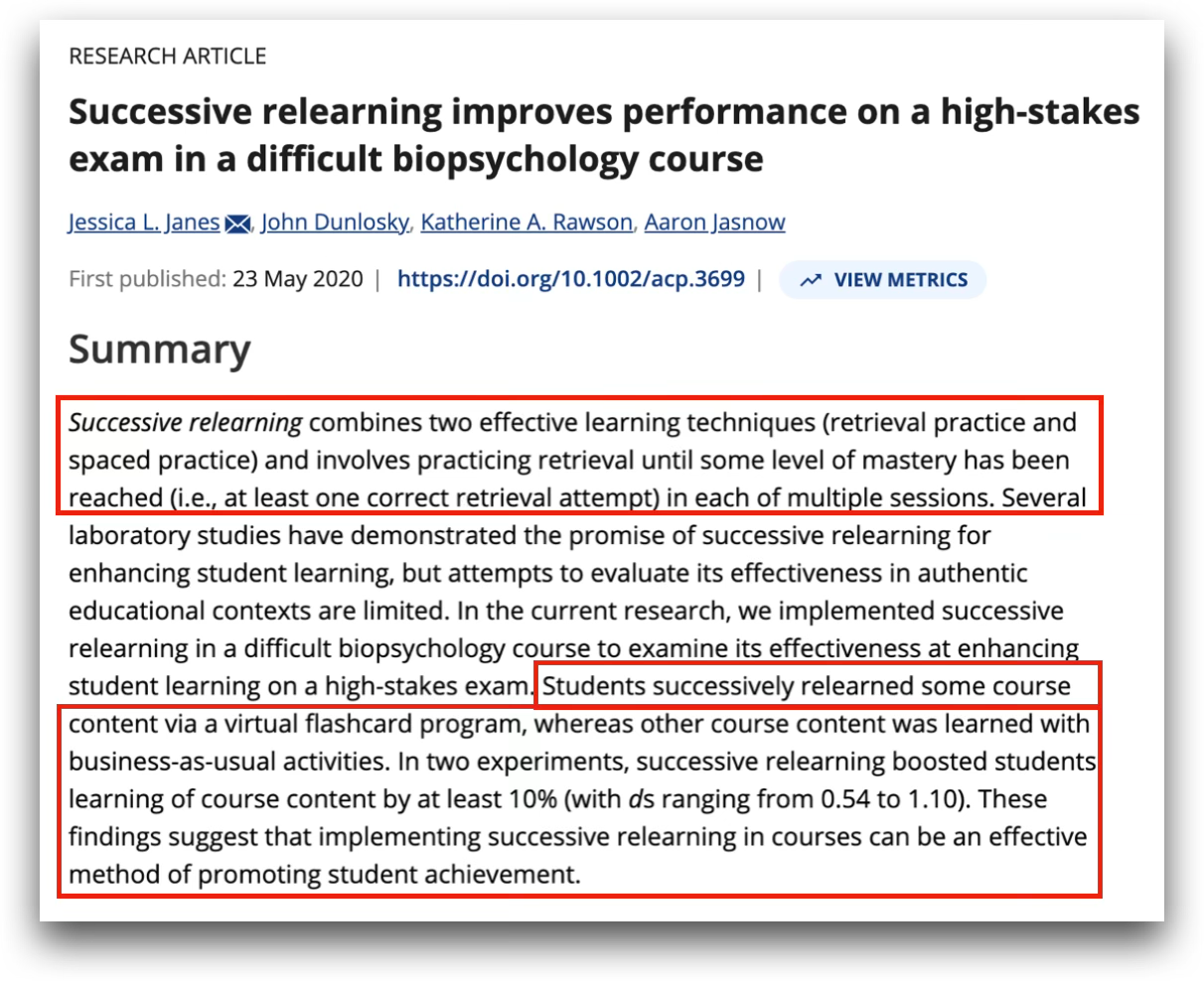
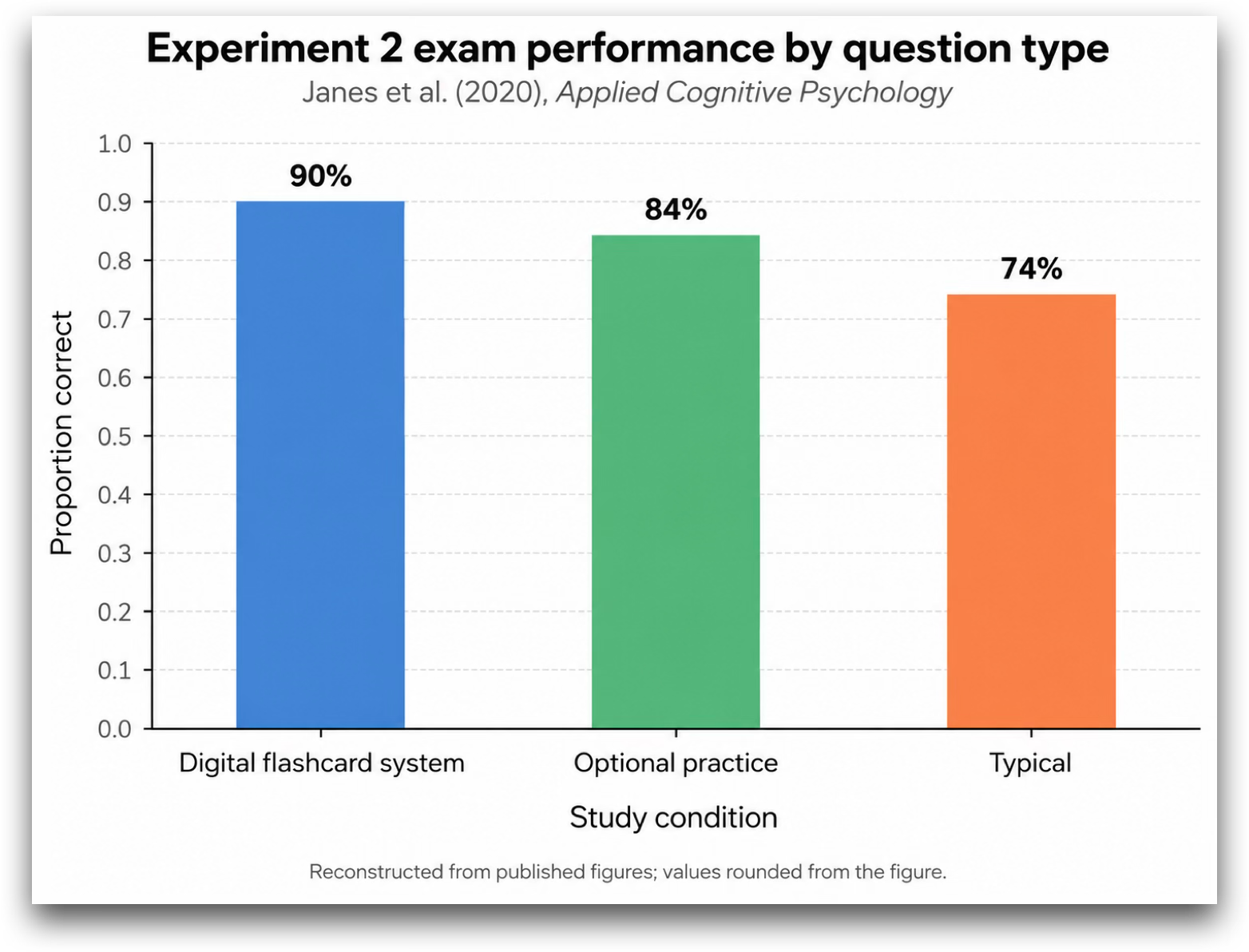
In this study, conducted in a difficult university biopsychology course, researchers used a method known as successive relearning. This essentially involved students attempting to recall information until they could successfully retrieve it, and then repeating this process across multiple spaced sessions. In other words, successive relearning is a DFS with a cooler name.
Students were assigned to practice some of their course material using their DFS, while other material was studied using their normal, standard study methods.
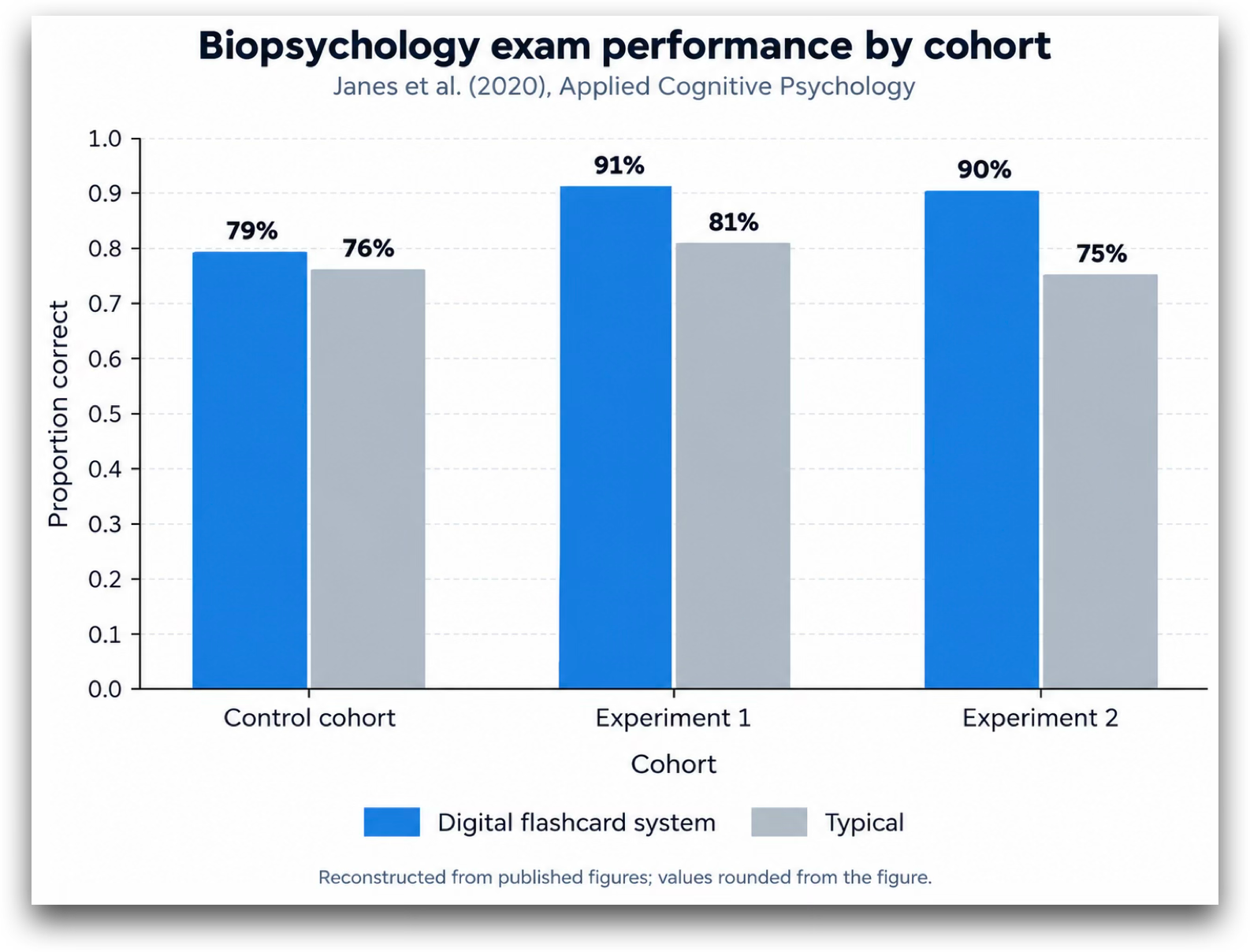
Across two experiments, the DFS-learned (successive relearning) material produced an improvement of 10 to 15 percentage points on the high-stakes exam, with effect sizes ranging from d = 0.54 to 1.10. That’s not a trivial difference. Ten to fifteen percentage points can quite easily be the difference between grades. All just from using a DFS.
What About Natural Spacing?
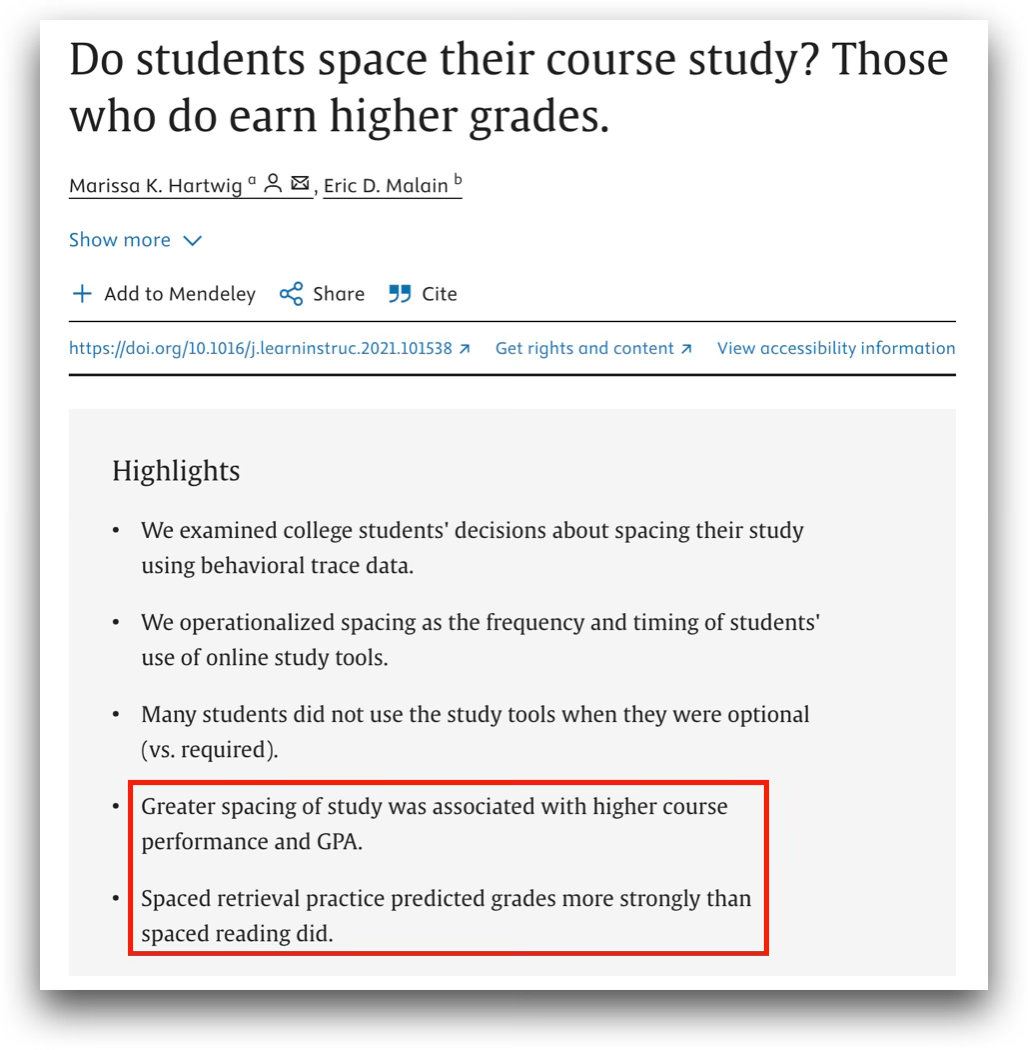
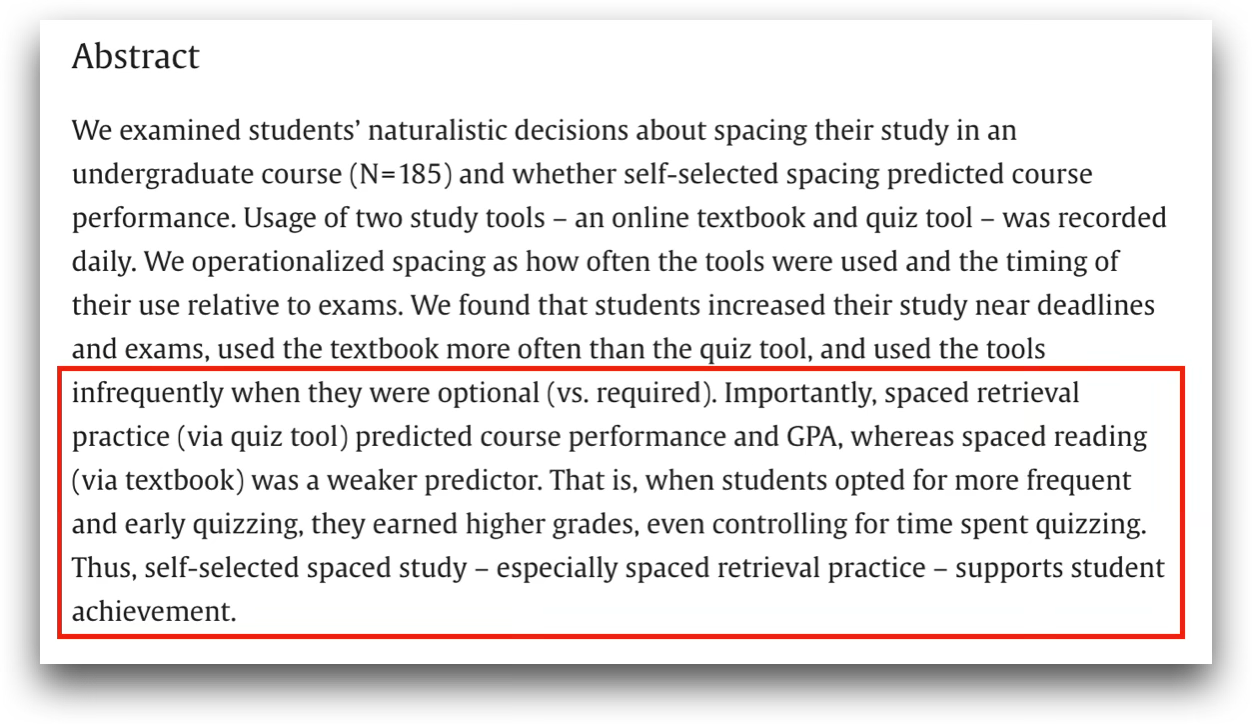
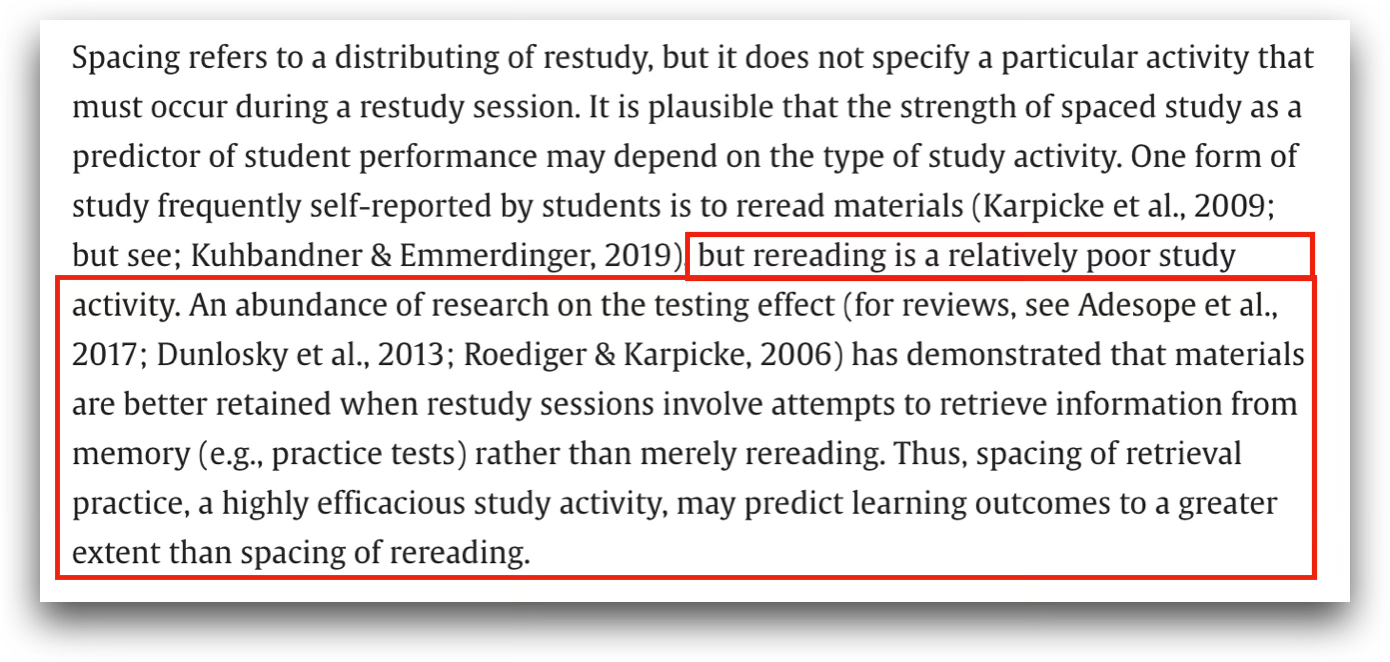
This paper tracked 185 university students throughout their course using an online textbook and quiz system. This allowed the researchers to record when students actually studied rather than simply asking them afterwards. Students who used the quiz system earlier and across more separate days achieved better grades. Further, this relationship remained even after accounting for the total amount of time spent quizzing.
Studying for ten hours and ‘studying’ for ten hours are not the same thing. In fact, they’re often polar opposites. How those ten hours are distributed, and what the student is actually doing during them, can materially affect what is retained. This is essentially the entire rationale behind SRS algorithms: rather than repeatedly reviewing everything equally, reviews are distributed according to how well the information is estimated to be retained. That which is known is rarely reviewed. That which is not is frequently. Both of these are features, not bugs.
What Do The Best Students Do?
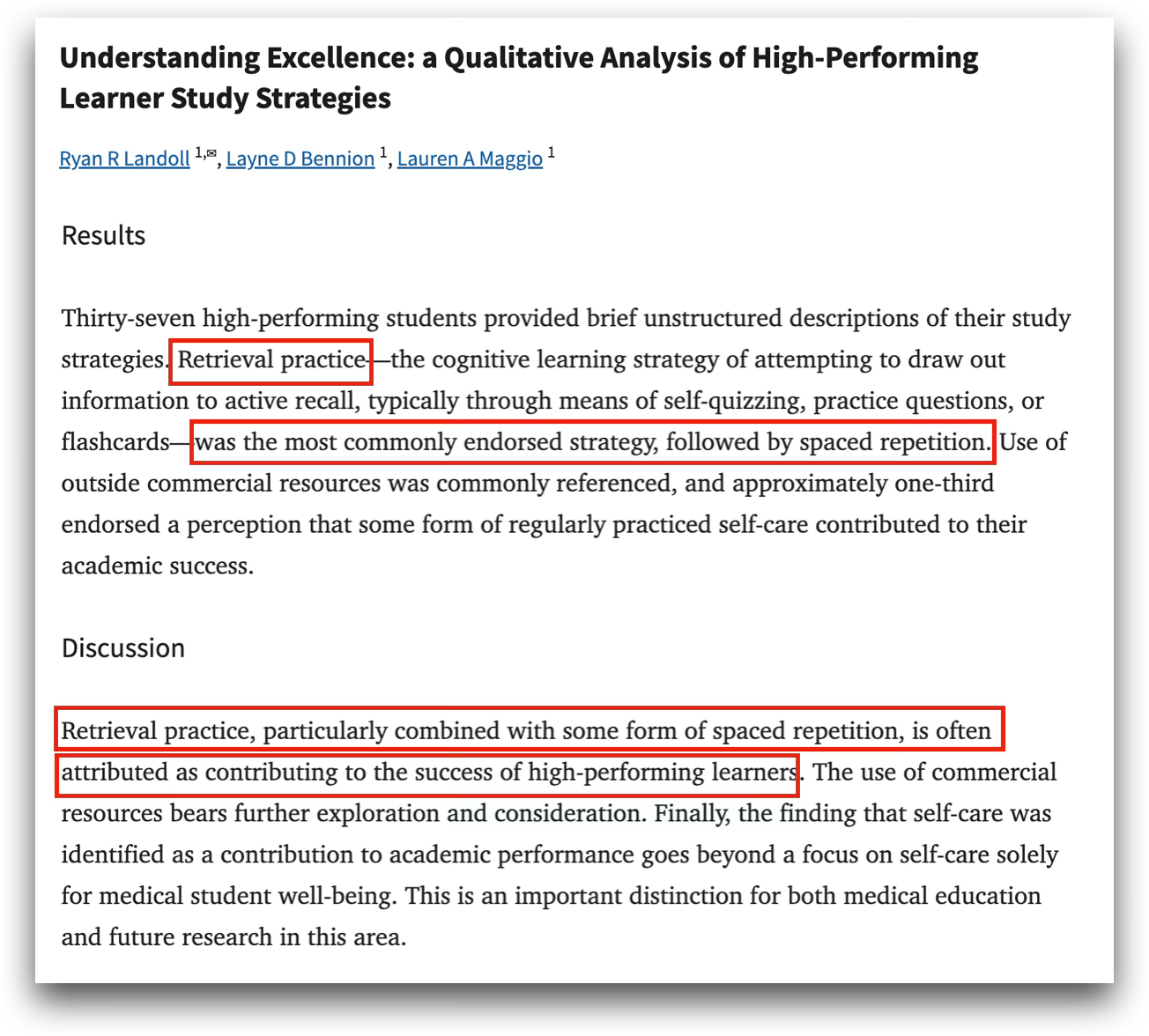
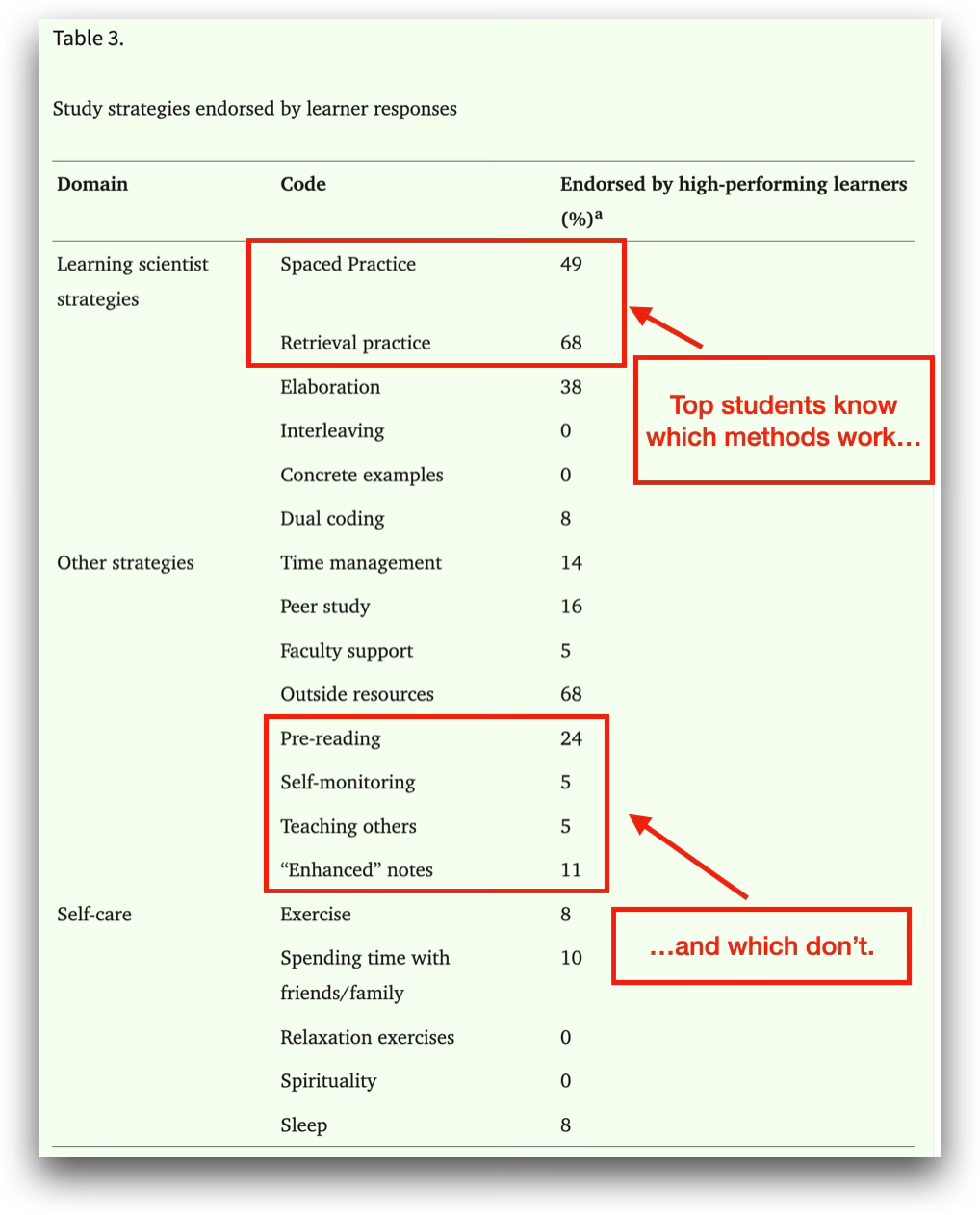
This 2021 study involved first- and second-year university medical students. To qualify as ‘high-performing’, students had to have scored above 90% on a standardised NBME science exam. Rather than asking whether flashcard users achieved higher grades, researchers instead looked at students who already had higher grades and simply asked them: how?
The vast majority described using recall, while half described using spacing. All other techniques were used considerably less, or even not at all.
How do most students study?
The following charts are adapted from Karpicke, Butler & Roediger (2009).
Flashcards Aren’t Necessarily Automatically Magic
There are pro’s and con’s to self-made versus pre-made versus LLM-made cards. There’s an article on the blog dedicated to this. The important thing is that the cards are high-quality, atomic, relevant, short and, most importantly, that the student attempts to recall the answer.
A student could create their own card containing an enormous paragraph with 4 different concepts being covered, turn it over immediately without attempting an answer, reread it three times, take more notes on it and then deem that as “using flashcards”. Very little, if any, of the research would give us any reason to expect that method to be particularly effective. It would not be. Or rather, it would be the same effectiveness as rereading/rewatching, highlighting and note-taking - methods which currently represent the bulk of most student study time.
Modern DFS can improve upon the old box-of-paper-cards approach because much of this organisation and optimisation can be automated thus freeing up essential working memory - not to mention additional features that are not possible with physical cards.
Summary
Students using DFS consistently achieve higher grades.
There’s a dose-response relationship: the more a student uses DFS, the better they do.
When flashcards are directly compared against standard studying in the same students, exam performance improved by 10-15 percentage points or more. This can very easily be a difference of grades.
Top students know which methods are most effective (and prioritise them), and know which methods are not.
This is directly opposite to the majority of students, a very high percentage of whom are either not aware or only partially aware.
This makes it impractically difficult for these students to ever possibly ‘catch up’.
The result is that a needlessly large percentage of students never reach their full potential.
If two of the strongest findings from decades of memory research are essentially “try to recall it” and “do so over time”, combining the two is hardly a revolutionary idea.
Given the strength and abundance of research, it does not seem unreasonable to expect that teachers’ #1 advice to students should be to setup a DFS and use daily - even if just for 10 minutes. Luckily, Shaeda has a built-in ‘10 minute daily’ option.
It is then the students responsibility from that point on.